
The hardest part of writing a paper is often not the research or the drafting, but deciding when to submit. Finished manuscripts can stall at this point — not because essential work is missing, but because authors are unsure when a paper is ready enough. This post examines why submission uncertainty and perfectionism are so common in academic publishing, and why waiting for complete confidence usually delays publication rather than improving quality. We introduce a calmer way to approach submission decisions, helping you distinguish between meaningful revision and unhelpful delay — without turning submission into a judgement about your competence.
1. Introduction
Most academics do not struggle because they submit too early. They struggle because they submit too late — or not at all.
In our work with researchers across disciplines and career stages, we repeatedly encounter manuscripts that are functionally finished but never quite cross the threshold into submission. The paper exists. The argument is there. The data have been analysed. The references are in place. And yet, weeks or months pass with no submission.
When authors describe why, the language is often cautious and self-critical:
I’m not sure it’s good enough yet.”
“I just want to improve the framing a bit more.”
“I feel it could still be stronger.”
These statements are not signs of laziness or lack of commitment. They reflect a structural uncertainty built into academic publishing itself.
Understanding that structure — rather than blaming yourself — is the first step toward calmer submission decisions.
If you are currently at this stage — unsure whether your paper is ready to submit — it can be helpful to step back and assess the manuscript more systematically.
We have developed a short, structured tool that helps you decide whether your paper is ready for submission — or whether a final revision phase would still strengthen it.
→ Download the Submission Readiness Diagnostic (20–30 min)
2. Why “ready enough” is such a difficult judgement
Unlike exams or coursework, academic manuscripts rarely come with clear completion criteria. Journals do not publish checklists that say: At this point, your paper is ready to submit. Supervisors and co-authors often give ambiguous feedback. Reviewer expectations vary widely. Even experienced researchers disagree on what constitutes a “strong” submission.
As a result, authors are left to make a decision under uncertainty.
This uncertainty is not accidental. It is inherent to a system where:
- evaluation happens after submission, not before,
- standards are comparative rather than absolute,
- and the final decision rests with anonymous reviewers and editors, not with the author.
Waiting for certainty in such a system is structurally unrealistic.
3. Perfectionism as a rational response — not a personal flaw
Perfectionism in academic writing is often framed as an individual trait: a tendency to overwork, overthink, or fear judgement. In reality, perfectionism is frequently a rational response to a high-stakes environment.
Publications affect careers. Rejections are common. Feedback can be harsh or contradictory. Under these conditions, polishing a manuscript further can feel safer than exposing it to external evaluation.
Importantly, this does not mean that all revision is unhelpful.
The challenge lies in distinguishing productive revision — work that materially improves clarity, argumentation, or positioning — from protective delay, where revision functions mainly to postpone submission.
4. How waiting quietly changes the relationship to the manuscript
When submission is postponed repeatedly, something subtle but important happens. The manuscript accumulates emotional weight.
What began as a paper becomes this paper I’ve been working on for so long. Expectations rise. The imagined stakes increase. The act of submission starts to feel like a judgement not only of the text, but of the author’s competence.
Paradoxically, this makes submitting harder, not easier.
At this stage, further revision rarely brings relief. Instead, it reinforces the feeling that the manuscript is never quite finished — because finishing now carries more emotional risk than it did earlier.
5. A structural reframe: submission is not a verdict
One of the most helpful shifts authors can make is to reframe what submission actually represents. Submission is not a declaration that your paper is flawless. It is a request for expert evaluation within a specific scholarly conversation.
Editors and reviewers expect manuscripts to have limitations. They expect arguments that can be sharpened. They expect revisions. This is precisely why the peer-review process exists.
From an editorial perspective, a submission is successful when it is:
- coherent and readable,
- methodologically sound,
- positioned clearly within the journal’s scope,
- and sufficiently developed to allow meaningful review.
- Perfection is not part of the requirement.
6. The cost of waiting longer than necessary
Delaying submission has consequences that are often underestimated. Beyond the obvious timeline effects, prolonged delay can lead to:
- loss of momentum,
- outdated references or framing,
- missed special issues or funding windows,
- and increased cognitive load from carrying unfinished work.
Perhaps most importantly, waiting reinforces the belief that confidence must come before action — when in academic publishing, confidence often follows submission, not precedes it.
7. From “Is it perfect?” to “Is it ready for review?”
A calmer submission decision becomes possible when the guiding question changes. Instead of asking: “Is this paper good enough?” a more useful question is: “Is this paper ready to be reviewed?” This shift does not lower standards. It aligns the decision with the actual purpose of submission.
A manuscript is ready for review when:
- the central claim is clear,
- the contribution is identifiable,
- the evidence supports the argument,
- and remaining weaknesses are refinements rather than structural gaps.
- This is a functional, professional threshold — not an emotional one.
If you want to apply this shift in a structured way, you can use the Submission Readiness Diagnostic.
It translates these criteria into a short decision process and helps you assess whether your manuscript meets the threshold for review — without turning the decision into a judgement about your competence.
→ Download the Submission Readiness Diagnostic
8. Practical criteria to distinguish revision from delay
To support this decision, we encourage authors to assess their remaining revision work using three practical questions:
1. Does this change affect the paper’s core argument or contribution?
If not, it is unlikely to be decisive for submission.
2. Is this something that could reasonably be addressed during peer review?
If yes, it does not need to be resolved before submission.
3. Am I revising to improve clarity — or mainly to reduce my own anxiety?
Both motivations are understandable, but only the former should determine timing.
Taken together, these questions help externalise the decision. Instead of relying on a vague sense of “not ready yet”, they anchor submission choices in editorial reality rather than emotional pressure. These questions are part of a broader decision framework that can help you assess your manuscript more systematically.
9. A structured aid: The Submission Readiness Check
To make this process more concrete, we created a short, focused decision tool:
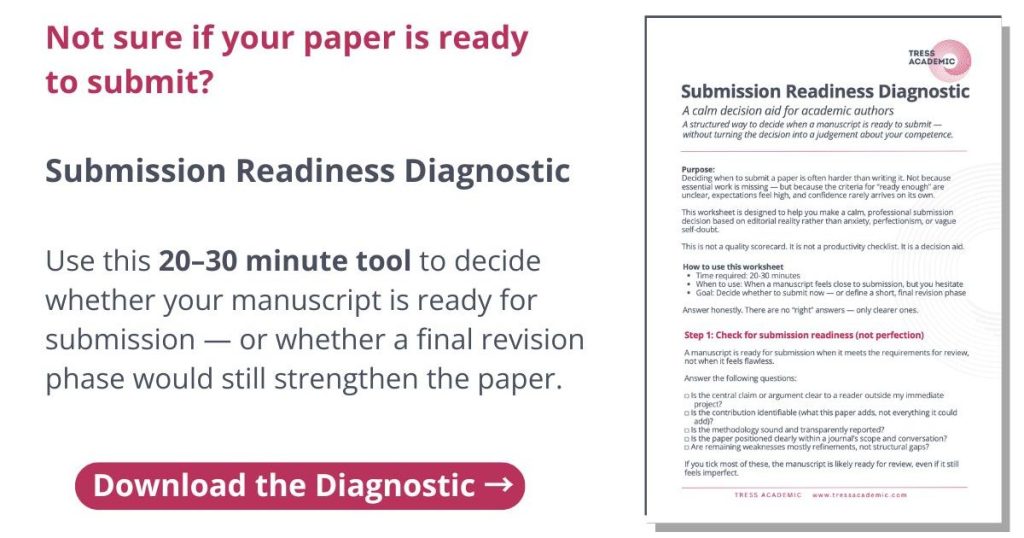
The Submission Readiness Diagnostic
This 20–30 minute worksheet helps you:
- assess your manuscript against editorial rather than emotional criteria
- distinguish between essential revision and protective delay
- decide consciously whether to submit now or define a short, final revision phase
The diagnostic is not a checklist or scorecard. It is a structured way to support a professional submission decision under uncertainty.
→ Download the Submission Readiness Diagnostic
10. What happens after submission — and why that matters
Many authors implicitly expect submission to bring immediate relief. In reality, it brings something else: movement.
Once a paper is submitted, it re-enters a structured process. Even rejection provides information. Reviews clarify expectations. Editors indicate fit. The manuscript becomes part of a dialogue again.
This movement is often what authors need most — and what endless polishing cannot provide.
If you would like to explore related topics on writing, revision, and publication decisions, you may find these Smart Academics Blog posts helpful:
- Research Communication in the Age of AI: Why Academic Writing Still Matters
- #144: Why Waiting for a “Quiet Phase” to Start Writing Rarely Works
- #135: How to speed up paper writing
- #122: How do you get published in a good journal?
- #115: How do you know that your research is good enough?
- #79: 5 decisions that make writing your paper so much easier
11. Conclusion
Uncertainty about when to submit is not a sign that you are doing academic work poorly. It is a predictable response to a system that offers few clear signals and high perceived stakes. By reframing submission as a professional step rather than a personal judgement — and by using structural criteria instead of emotional ones — authors can decide more calmly and move forward with less self-doubt.
A paper does not need to be perfect to deserve review.
It needs to be ready enough to enter the conversation.
If you are currently deciding whether to submit your paper, you do not need to rely on intuition alone.
You can use the Submission Readiness Diagnostic to make a clear, structured decision in about 20–30 minutes.
→ Download the Submission Readiness Diagnostic
© 2026 Tress Academic