
Finishing a research paper is rarely a purely technical process. Many manuscripts reach a stage where the remaining revisions are small, yet the decision to submit still feels uncertain. This hesitation often has less to do with quality and more to do with unclear decision criteria. In this article, we examine how to distinguish necessary revision from unnecessary delay — and how to decide more calmly whether your paper is ready for submission.
1. Introduction
A manuscript is almost finished.
The central argument is clear.
The analyses are complete.
The structure works.
Yet the paper remains on your desk.
You open the document again, adjust a paragraph, refine a figure, rewrite a sentence in the introduction. None of these changes feel decisive, but submitting the paper still feels premature.
This moment is common in academic writing. The difficulty lies not in writing the paper, but in deciding when the paper is ready to enter the review process.
Many researchers assume that the correct decision will become obvious once the manuscript reaches a certain level of quality. In practice, however, submission decisions rarely become clear through revision alone.
The real issue is usually structural: the criteria for deciding whether a paper is ready remain implicit.
2. The hidden decision problem in academic writing
Academic publishing encourages careful work, strong argumentation and thorough revision. These norms are valuable, but they also create a subtle difficulty.
The boundary between necessary improvement and unnecessary delay is rarely clearly defined.
Researchers therefore tend to rely on internal signals such as:
- whether the paper feels convincing
- whether they personally feel confident submitting
- whether one more revision might make the paper “safer”
Unfortunately, these signals are unreliable.
Confidence often arrives late in the writing process — sometimes after submission rather than before. Meanwhile, additional revisions frequently produce only marginal improvements.
The result is a familiar situation: a paper that is technically ready for submission remains in revision because the decision criteria have never been clarified.
If this feels familiar, you may find this useful:
3. The difference between structural gaps and refinements
A useful way to approach the submission decision is to distinguish between two types of remaining work.
Structural gaps
Structural issues affect whether the paper can be evaluated properly during peer review.
Examples include:
- the main argument is still unclear
- the contribution cannot yet be identified
- the methodology is insufficiently explained
- the manuscript is not clearly positioned within the journal’s conversation
If these issues remain unresolved, revision before submission is sensible.
Refinements
Refinements improve clarity or presentation but do not fundamentally change the paper’s evaluability.
Examples include:
- improving transitions between sections
- adjusting wording or phrasing
- polishing the introduction
- shortening or expanding parts of the discussion
These revisions can strengthen a paper. However, they rarely determine whether a journal can review it.
When most remaining issues belong to this second category, the manuscript is often already ready for submission.
4. Why submission rarely feels comfortable
One reason researchers hesitate to submit is that submission decisions are often framed as personal judgements.
Submitting a paper can feel like declaring:
“This work is good enough.”
In reality, submission means something different.
Submitting a paper simply means requesting expert evaluation within the peer-review process.
Peer review exists precisely because manuscripts are not final when they are submitted. Reviewers and editors expect that weaknesses will be identified and addressed during revision.
The purpose of submission is therefore not to present a flawless document. It is to move the work into the scholarly conversation where it can be evaluated and improved.
Understanding this distinction helps reduce the emotional weight of the decision.
5. Which revisions belong to peer review
Another useful question is whether a particular improvement must happen before submission — or whether it can reasonably occur during the review process.
In many disciplines, reviewers frequently request revisions such as:
- additional literature integration
- clarifications of argumentation
- expanded discussion of limitations
- improved explanation of methods or data
These types of changes are part of the normal publication process.
Holding a manuscript back until every possible improvement has already been implemented can therefore delay publication unnecessarily.
A more realistic approach is to ask:
Would this issue prevent reviewers from evaluating the manuscript fairly?
If the answer is no, submission may already be justified.
6. The revision-delay trap
At this stage, many manuscripts enter what might be called the revision-delay trap.
The paper is not being improved strategically. Instead, the author continues revising because the alternative — submitting — feels uncomfortable.
Typical signs include:
- repeatedly editing the same sections
- searching for additional literature that changes little
- postponing submission until confidence increases
- waiting for a moment when the paper feels “fully convincing”
Paradoxically, these behaviours often slow down academic progress more than rejection would.
A rejected paper can be revised and resubmitted.
A paper that remains indefinitely in revision cannot.
Recognising this dynamic is often the first step towards making a deliberate submission decision.
7. A structured way to decide
One helpful approach is to move away from intuition and instead use explicit criteria.
A manuscript is typically ready for submission when three conditions are met:
1. The argument is understandable.
A reader outside the immediate project can follow the paper’s central claim.
2. The contribution is identifiable.
The manuscript clearly states what it adds to the existing literature.
3. The work can be evaluated.
The methods, data and reasoning are presented transparently enough for reviewers to assess.
When these conditions are satisfied, the manuscript usually meets the threshold required for peer review.
At that point, further revisions may improve the paper — but they are no longer necessary for submission.
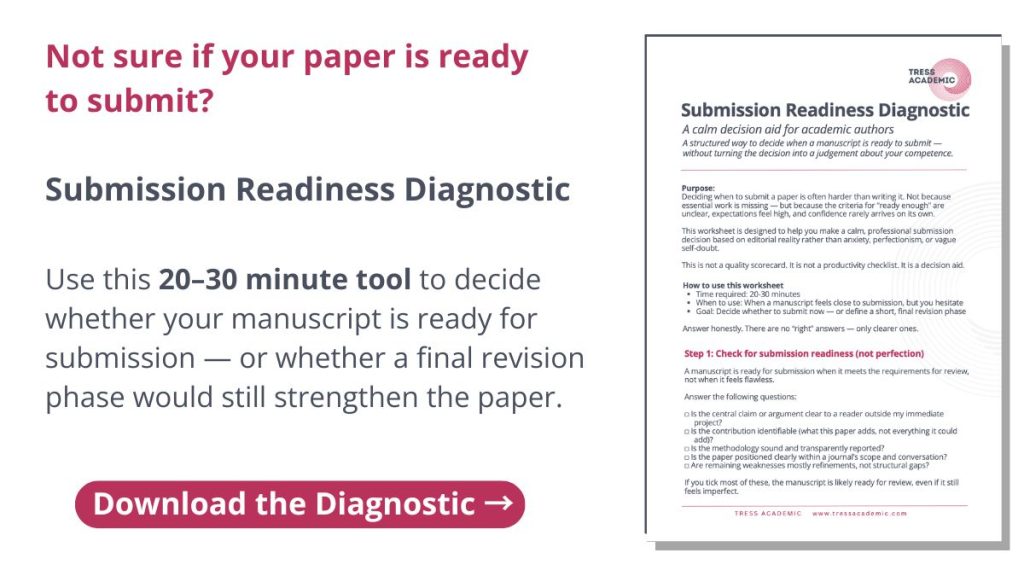
If you would like a structured way to check these criteria in your own manuscript, you can use the Submission Readiness Diagnostic — a short 20–30 minute reflection tool for academic authors.
→ Use the Submission Readiness Diagnostic to check your paper
8. When additional revision is useful
Of course, there are situations where postponing submission is sensible.
A short, focused revision phase may be appropriate when:
- the argument still needs structural clarification
- the contribution is not yet clearly defined
- a key methodological explanation is missing
- the target journal has not yet been identified
In these cases, additional work can substantially strengthen the manuscript.
The important point is that this revision phase should be deliberate and time-limited, not open-ended.
Clear revision goals often help prevent the manuscript from drifting into endless editing.
9. From revision to movement
Academic publishing is a process built on iteration.
Papers rarely become strong through solitary perfection. They improve through cycles of feedback, revision and resubmission.
Submitting a manuscript therefore represents an important transition: the moment when the work leaves the private writing phase and enters the scholarly evaluation process.
Seen in this light, submission is not a risky step. It is a normal and necessary stage in the life of a research paper.
Conclusion
Deciding when to submit a manuscript is often harder than writing it.
The difficulty usually arises because the decision is framed emotionally rather than structurally. Researchers wait for confidence, certainty or a sense of completeness that rarely arrives.
A clearer approach is to ask simpler questions:
Is the argument understandable?
Is the contribution visible?
Can the work be evaluated by reviewers?
If these conditions are met, the manuscript is typically ready to move forward.
Submission does not end the revision process. It begins the next stage of it.
Not sure whether your paper is ready to submit — or just feels unfinished?
Use the Submission Readiness Diagnostic — a structured 20–30 minute reflection tool to help you decide whether to submit now or continue revising.
It helps you:
- check whether your manuscript meets realistic submission criteria
- distinguish between necessary revisions and unnecessary delay
- make a clear, confident submission decision
Many strong papers are delayed not by quality, but by unclear decision criteria.
👉 Get the Submission Readiness Diagnostic (free PDF, 20–30 min)
Ongoing discussion in the academic community
A recent discussion among researchers from different disciplines and career stages has explored this question from multiple perspectives.
The discussion was initiated by a real case in which a PhD student was sitting on a manuscript that was already technically ready for submission, yet continued revising due to unclear decision criteria and differing expectations with her supervisors.
Several themes emerged in the exchange:
- the difficulty of distinguishing meaningful revision from diminishing returns
- the question of who takes responsibility for the submission decision
- the lack of explicit criteria for determining when a paper is “ready”
These perspectives reinforce a key point of this article: the challenge is often not the writing itself, but the absence of clear decision criteria for moving from revision to submission.
→ You can explore the full discussion and different perspectives here: https://www.linkedin.com/posts/gunthertress_a-phd-student-i-spoke-to-last-week-is-sitting-activity-7447519853982208000-EJ2U
Resources & Further Reading
Related Smart Academics Blog posts
- Research Communication in the Age of AI: Why Academic Writing Still Matters
- Good Enough to Submit? Why Many Academics Wait Too Long
- Why Waiting for a Quiet Phase to Start Writing Rarely Works
- How to Speed Up Paper Writing
Related programme
If you would like structured guidance from first draft to submission, you may be interested in the Paper Writing Academy (PWA), where researchers develop a manuscript step by step with clear milestones and feedback.
© 2026 Tress Academic