
You open your paper, make a few small edits, and close it again — unsure what to do next. You’re not avoiding the work. You’re already in it. But the writing does not move forward. This article shows why this happens — and how to move forward in a structured way. Instead of relying on motivation or “finding time”, you will learn how to reduce uncertainty, define your next step, and start writing again with clarity.
1. Introduction
Starting a research paper is rarely a single moment. More often, it is a phase that stretches over days or weeks, during which progress feels slow or inconsistent.
You return to the document, adjust a paragraph, revisit a figure, or reread earlier sections. The work continues, but the paper does not seem to move forward.
This can be frustrating, particularly when the underlying research is already complete or well advanced. In many cases, the difficulty is not writing itself. It is the absence of a clear structure that makes writing possible.
2. Why starting often feels harder than writing
Writing is often described as a task that requires time, discipline, and focus. This explains part of the challenge, but not why writing can feel almost impossible at certain moments — even when time is available.
The difficulty usually arises when writing is expected to do too much at once. Instead of simply putting ideas into words, you are simultaneously trying to clarify your argument, decide what matters, organise the structure, and choose how to express it. Writing becomes the place where thinking, structuring, and drafting all happen at the same time.
This creates a high cognitive load. Progress slows down not because the work is too complex, but because too many decisions remain unresolved. As a result, even small writing steps feel disproportionately difficult to begin.
3. What changes when clarity is present
In structured writing environments, a consistent pattern emerges. Researchers arrive with data, notes, partial drafts, and ideas — yet many initially struggle to write productively.
What changes is not motivation or effort. It is the level of clarity.
Once the central idea and a basic structure become visible, writing becomes more direct. Short, focused sessions begin to produce tangible results. Instead of hesitating over what to write, researchers are able to follow a clearer line of thought.
Before this shift, writing often feels fragmented and effortful. After it, the same work becomes more continuous and manageable. The difference lies not in intensity, but in orientation.
This suggests a useful conclusion: writing does not create clarity. It depends on it.
4. Three structural reasons why writing stalls
In most cases, writing does not stall randomly. It slows down for identifiable structural reasons. If you recognise one of the patterns below, the issue is not writing ability or discipline. It is how the task is currently defined.
1. The task is too large
“Write the paper” is not a task you can start. It is an outcome. When the task remains at this level, it contains too many implicit decisions: which section to write, what exactly to include, and what would count as sufficient progress. This makes it difficult to begin. You may find yourself opening the document without a clear entry point, moving between sections without completing one, or postponing writing because you feel you need a longer, uninterrupted block of time. In this situation, the problem is not time. It is that the task has not yet been reduced to something concrete and executable.
2. The structure is unclear
Writing depends on knowing where ideas belong. When the structure of the paper is not yet visible, writing turns into exploration rather than execution. Each paragraph becomes an attempt to figure out both what to say and where it fits within the overall argument. This often leads to writing and rewriting the same sections, moving text around, or deleting paragraphs that no longer seem to fit. You may have a general sense of your argument, but without a clear structure, it remains difficult to translate that into coherent text. In this situation, the difficulty lies not in writing itself, but in the fact that the paper is still being shaped.
3. The next step is undefined
Even when you have a general idea and a partial structure, writing can stall if the next step is not clearly defined. You may know what the paper is about, but not what to do next. This often results in rereading existing text instead of adding new content, making small edits that do not move the paper forward, or waiting until you feel clearer before starting. The intention to write is present, but it is not linked to a specific action. In this situation, the issue is not motivation. It is that the next concrete step has not been identified.
Across all three cases, the pattern is similar. Writing becomes difficult when too many decisions remain open at the same time. Reducing these decisions — even slightly — is often enough to create movement again.
5. A different perspective: writing starts before writing
A useful way to approach this situation is to shift the focus of the question. Instead of asking how to write the paper, it is often more effective to ask what needs to be clarified before writing can proceed.
This reframing changes the role of writing. It is no longer treated as the starting point, but as a later step that follows a small number of prior decisions. When these decisions are made in advance, writing becomes less about exploration and more about articulation.
In practice, this means making three elements sufficiently clear. The first is the central claim — what the paper is trying to show. The second is a working structure that organises the main components of the argument. The third is a concrete next step that can be carried out without resolving the entire paper.
When these elements are in place, writing no longer requires solving multiple problems at once. It becomes a more contained activity, focused on expressing what has already been defined. This reduction in complexity is often enough to restore movement.
6. A structured way to start writing again
Rather than attempting to write full sections from the outset, it is often more effective to begin by creating a small amount of clarity.
Start by defining the focus of the paper in a few sentences. This helps establish what the paper is about and what falls outside its scope. From there, sketch a simple structure by listing the main sections and the key points you expect to include. This does not need to be complete or refined — it only needs to be usable.
Once a basic structure is in place, identify one concrete next step. This could be describing a specific result, drafting a short paragraph, or outlining a section in more detail. The key is that the step is clearly defined and limited in scope.
With this preparation, begin a short writing session of 20–30 minutes. During this time, focus only on drafting, without editing or restructuring. The objective is not to produce a polished result, but to create movement.
This approach separates clarification from writing and reduces the number of decisions that need to be made simultaneously. As a result, starting becomes more straightforward and progress easier to sustain.
Understanding this principle is one thing. Applying it consistently is another.
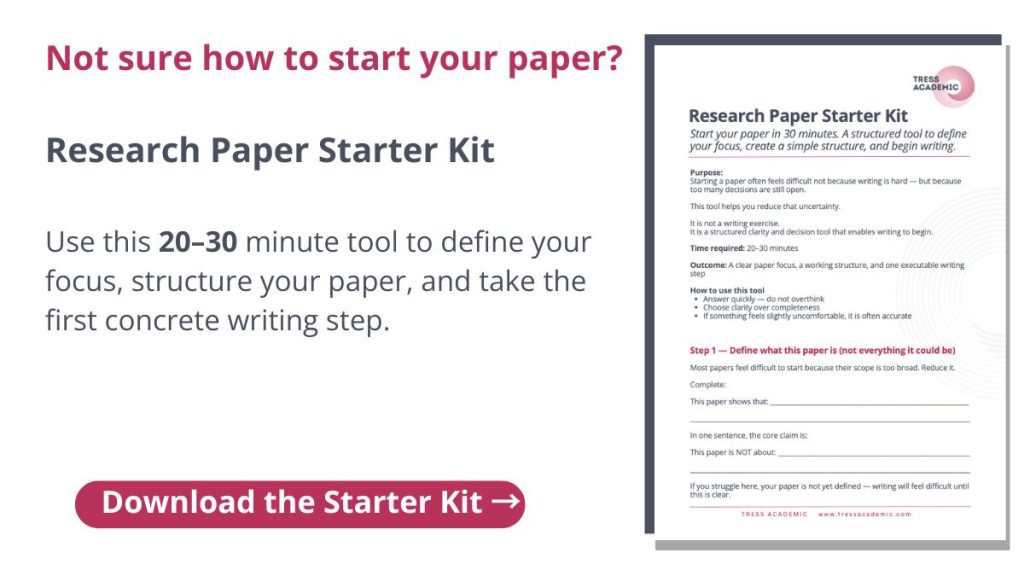
If you want to translate this approach into a concrete starting point for your own paper, the following tool provides a simple structure to guide you through these steps.
7. From starting to completing a paper
Starting a paper is only one phase of the writing process. Many researchers experience a similar pattern later on: initial progress is followed by slowing momentum, repeated revisions, or uncertainty about how to proceed.
The underlying dynamic is often the same. At different stages of writing, new forms of uncertainty emerge. Early on, the difficulty lies in defining the focus and structure. Later, it may shift to integrating feedback, refining the argument, or deciding when a paper is ready to submit.
In each case, progress depends less on effort alone and more on whether the next step is clearly defined.
This is why writing a paper is rarely a single task. It is a sequence of transitions: from idea to structure, from structure to draft, from draft to revision, and from revision to submission. Each transition requires a different kind of clarity.
When these transitions are not supported, writing tends to slow down again — even if the initial start was successful.
Structured writing environments aim to make these transitions more visible and manageable. Rather than relying on isolated writing sessions, they provide a framework that supports the full process from first idea to completed manuscript.
In programmes such as the Paper Writing Academy (PWA), this structure is made explicit through clear milestones, defined steps, and ongoing feedback. The intention is not only to help researchers start writing, but to support them in completing a paper in a systematic and sustainable way.
8. Conclusion
When writing feels difficult to start, the issue is usually not discipline or time. It is clarity.
Writing becomes possible when:
- the structure is visible
- the next step is defined
- uncertainty is reduced
You do not need to start with the whole paper. You need to start with the next part of it.
Once that step is clear, starting is no longer the challenge — continuing becomes possible.
Not sure how to start your paper?
Use the Research Paper Starter Kit — a short structured tool to help you:
- define your paper’s focus
- create a simple structure
- identify your next writing step
- start writing within 30 minutes
Get the Research Paper Starter Kit (free PDF, 20–30 min)
Resources & Further Reading
- Research Communication in the Age of AI: Why Academic Writing Still Matters
- How to speed up paper writing
- Why waiting for a “quiet phase” to start writing rarely works
- Good enough to submit? Why many academics wait too long
Related programme
If you would like structured guidance from first draft to submission, you may be interested in the Paper Writing Academy (PWA).
© 2026 Tress Academic