
You have the research. You have data, notes, maybe even draft text. You have spent weeks or months working on the project. Yet when you try to turn all of this into a paper, something does not quite come together. Sections feel unclear, ideas overlap, and the structure never quite works. This is one of the most common challenges in academic writing. In many cases, the difficulty is not the research itself, but how it is organised into a coherent paper. Without a clear structure, writing becomes slow, fragmented, and difficult to continue. This article shows why structuring a research paper often feels difficult — and provides a simple working template you can use to clarify your argument and move forward.
1. Why structuring a research paper feels difficult
Structuring a research paper is not a single decision. It requires several decisions at once.
You need to determine what the paper is really about, which ideas are central and which are secondary, how different parts of the research relate to each other, and in what order they should be presented. At the same time, you need to ensure that everything contributes to a coherent overall argument.
In practice, these decisions are often not made explicitly. Instead, they are pushed into the writing process. You begin drafting, adjust a paragraph, move text around, and gradually try to “find” the structure as you go.
This approach makes writing unnecessarily difficult. The task becomes overloaded because writing is expected to do too much at once: clarify the argument, organise the material, and produce text. As a result, even small writing steps can feel unclear or effortful.
2. What a good structure actually does
A common assumption is that a good paper structure is simply a matter of following a standard format. Many researchers think in terms of sections such as Introduction, Methods, Results, and Discussion. These formal sections are useful, but they are not the structure itself.
A good structure does something more fundamental. It makes the logic of the paper visible. A well-structured paper makes four things immediately clear:
- what problem the paper addresses
- what the paper is trying to show
- how the argument is developed
- and why the findings matter
In this sense, structure is not about headings. It is about orientation. A useful structure guides the reader through the argument step by step. It reduces ambiguity and makes the progression of ideas easier to follow.
3. Formal structure vs. working structure
It is helpful to distinguish between two types of structure.
The formal structure refers to the conventional sections of a paper. These are often defined by the journal or the discipline. They provide a general framework.
The working structure, in contrast, refers to the internal logic of your specific paper. It answers questions such as:
- What is the central claim?
- What are the key components of the argument?
- How do these components relate to each other?
Many difficulties arise when the working structure is unclear. In that case, the formal structure alone is not enough. You may have the correct section headings, but the content within them does not form a coherent line of reasoning.
A clear working structure does not replace the formal structure. It makes it meaningful.
4. A simple template for structuring your paper
Instead of trying to define the entire structure at once, it is more effective to start with a small number of core elements.
A useful working template consists of the following parts:
a) The problem or gap
What is not yet understood, resolved, or explained in your field? This defines the starting point of your paper.
b) The aim or central claim
What does your paper show? This is the core statement that the paper develops.
c) The approach
How do you address the problem? This includes your method, data, or analytical perspective
d) The evidence or results
What did you find? This is the material that supports your claim.
e) The meaning of the findings
What do the results tell us? This is where interpretation begins.
f) The contribution and implications
Why does this matter? What does your paper add to the field?
This template is not a rigid format. It is a way of making the core elements of your argument visible.
In many papers, these elements are already present — but not clearly defined or not well connected. Making them explicit is often enough to create a much clearer structure.
5. How to use this template in practice
The goal is not to force your paper into a predefined structure. It is to clarify the relationships between its key elements.
A simple way to proceed is to write one or two sentences for each part of the template. This creates a rough map of your paper. At this stage, the structure does not need to be perfect. It only needs to be usable.
Once these elements are visible, you can begin to organise them into sections. Some elements may be combined. Others may need more space. The exact form depends on the paper.
What matters is that the overall line of reasoning becomes clearer.
6. Where structure usually breaks down
When a paper feels difficult to structure, there are often specific underlying issues.
One common problem is that the scope of the paper is too broad. If the paper tries to address too many questions at once, it becomes difficult to define a clear line of argument.
Another issue is an unclear central claim. If it is not clear what the paper is trying to show, it becomes difficult to decide what belongs in the paper and what does not.
In some cases, results are presented without being clearly connected to the argument. The reader sees what was done, but not how it contributes to the overall point.
A further difficulty can arise in the discussion section, where findings are repeated rather than interpreted. This often indicates that the meaning of the results has not yet been fully clarified.
These issues are not separate from structure. They are expressions of an unclear structure. If you recognise this in your own paper, the next step is not to keep adjusting text — but to make these decisions explicit.
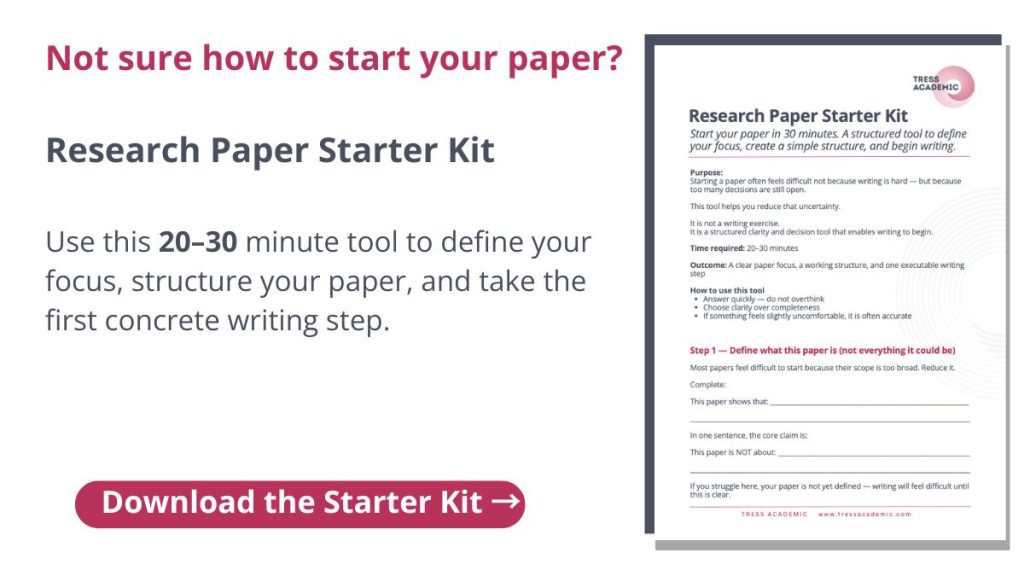
We have created a short practical tool for this:
→ Research Paper Starter Kit
A focused 20–30 minute worksheet to help you move from confusion to a clear structure:
- define your paper’s core idea
- create a clear working structure
- identify your next writing step
→ Download the Research Paper Starter Kit (free PDF, 20–30 min)
7. A structured way to begin
If your paper currently feels unclear, it can help to step back from writing and focus on a small number of structural decisions. Instead of trying to improve the text, focus on defining the core elements of your paper first.
A simple way to do this is to work through three steps:
First, clarify your central claim. What is the one thing your paper is trying to show?
Second, identify the key components of your argument. What are the main elements that support this claim?
Third, sketch a basic sequence. In what order does the reader need to understand these elements?
At this stage, the goal is not precision, but orientation. You are creating a rough map — not a finished structure. This often reduces uncertainty enough to make writing possible again. Once the direction is clear, the next steps become much easier.
8. From structure to a complete paper
A clear structure is an important step, but it is not the final one.
Once the structure is in place, the next stages involve drafting, revising, and refining the argument. At this point, new questions typically emerge: how to develop sections, how to integrate feedback, and how to decide when the paper is ready to submit.
In practice, writing a paper is not a single task but a sequence of transitions — from idea to structure, from structure to draft, and from draft to submission.
When these transitions remain implicit, progress often slows down again. When they are made explicit, the process becomes more manageable and easier to sustain.
9. Conclusion
When a research paper feels difficult to structure, the issue is rarely a lack of effort or discipline. More often, too many decisions remain unresolved at the same time.
A simple working structure makes these decisions visible. It clarifies the argument and reduces complexity. As a result, writing becomes more focused and easier to continue.
You do not need a perfect structure to begin.
You need one that is clear enough to start.
Once that clarity is in place, writing becomes less about figuring things out — and more about expressing what is already understood.
Use the Research Paper Starter Kit — a short tool to help you define your focus, create a working structure, and start writing with clarity.
→ Download the Research Paper Starter Kit (free PDF, 20–30 min)
Resources & Further Reading
- How to start writing a research paper when you feel stuck
- How to speed up paper writing
- Good enough to submit? Why many academics wait too long
- How do you get published in a good journal?
- Research Communication in the Age of AI: Why Academic Writing Still Matters
Related programme
If you would like structured guidance from first draft to submission, you may be interested in the Paper Writing Academy (PWA).
The programme provides:
- clear structure across the writing process
- step-by-step progression from idea to manuscript
- feedback and support throughout
Learn more about the Paper Writing Academy
© 2026 Tress Academic