
You may have strong results and still not have a paper. The data are there, the analyses are done, and you may even know that the work is worth publishing. Yet when you try to turn the material into a manuscript, the paper does not take shape. This article explains why results alone do not automatically become a paper — and how to move from “I have findings” to a clear paper focus, structure, and next writing step.
1. Introduction
There is a particular moment in academic writing that can feel surprisingly difficult. The research has produced something. You have data, observations, analyses, interview material, figures, tables, or experimental results. You may have presented parts of the work already, discussed it with supervisors or colleagues, and received encouraging feedback.
Yet the paper itself is still not there.
This can be confusing because, from the outside, it looks as if the hard part has already been done. The research exists. The results are available. The next step should be writing. In practice, however, this transition is often where researchers get stuck.
The reason is that research results do not automatically contain a paper. They contain material. A paper requires something more specific: a focused argument, a clear selection of results, and a structure that helps the reader understand what the findings mean.
This is why “I have results” and “I have a paper” are not the same thing.
2. Why this feels difficult
Turning results into a paper is difficult because it requires a shift in perspective. During the research process, you are often concerned with producing, checking, analysing, and understanding your material. You are close to the work, and you know the history behind it: the failed attempts, the methodological adjustments, the surprising patterns, the side findings, and the details that took months to resolve.
A journal paper asks for something different. It does not usually need the full history of the project. It needs a focused version of the work that serves one central purpose.
This is where the difficulty begins. When you sit down to write, you may try to include too much because all of it feels relevant. You may struggle to decide which results are central and which are supporting. You may also find it difficult to move from “what we found” to “what this paper shows”.
At that point, writing becomes overloaded. You are not only writing sentences. You are trying to decide what the paper is about, what belongs in it, what should stay out, and how the reader should be guided through the material. It is not surprising that progress slows down.
3. What is actually going on
The underlying problem is usually not a lack of material. It is a lack of transformation.
Research material has to be transformed into a paper argument. This means that the results need to be organised around a central message. Without that message, the paper easily becomes a report of everything that was done rather than a contribution that readers can understand and evaluate.
This distinction matters. A paper is not a storage place for all results from a project. It is a communication form. It selects, arranges, and interprets material for a particular scholarly purpose.
When that purpose is unclear, the paper remains unstable. The introduction becomes difficult because the problem is not yet clearly framed. The results section becomes too broad because everything seems potentially relevant. The discussion becomes repetitive because the meaning of the findings has not yet been defined.
The solution is not to write more. It is to clarify what the results are meant to become.
4. Key distinction: results are not yet a paper
A useful distinction is between results and contribution.
Results answer the question: What did you find?
Contribution answers a different question: What does this finding add to the field?
This difference is small but important. A paper becomes much easier to write when you stop asking only what your results are and begin asking what they make visible, clarify, challenge, or extend.
For example, a result may show that a certain pattern exists. The contribution may be that this pattern changes how a process is understood, reveals a limitation in previous assumptions, or offers evidence for a relationship that has not been sufficiently examined.
The same set of results can often support several possible papers. This is why the central decision is not simply “What do I have?” but “What is the paper I want to make from this material?”
Once that decision becomes clearer, structure becomes easier. You can begin to select results, organise sections, and write with a stronger sense of direction.
5. A practical framework for turning results into a paper
A simple way to move from results to paper is to work through six questions.
First, identify the main finding. What is the most important result, pattern, insight, or relationship that emerged from your work? This does not need to capture everything. It should identify the element around which the paper can be built.
Second, ask what this finding shows. This moves the paper beyond description. You are not only reporting that something happened; you are clarifying what the finding helps readers understand.
Third, define the problem or gap the paper responds to. A paper needs a reason to exist. The reader needs to know why this result matters in relation to existing knowledge, debate, practice, or method.
Fourth, decide which results are essential. Not every result from the project belongs in the paper. Some findings may be interesting but not necessary for the central argument. Others may belong in a later paper.
Fifth, identify the sequence. The reader cannot receive all information at once. You need to decide what they must understand first, what follows from that, and where the main evidence should appear.
Sixth, formulate the contribution. This is the point where the paper becomes more than a report. It states what the work adds and why the reader should care.
These questions do not produce a finished manuscript. They produce a working structure. That is often enough to make writing possible.
6. How to apply this in practice
Start with your results, but do not begin by writing the results section. Instead, write a short statement that begins with: “This paper shows that…” This sentence may be rough at first, but it forces a useful decision. It asks you to turn material into a claim.
Then make a second list: which results are necessary to support this claim? Keep this list short. If you need every result to make the paper work, the focus is probably still too broad.
Next, sketch the reader’s path. Ask what the reader needs to understand before they can appreciate the finding. This will usually point you towards the introduction and the structure of the argument. It may also reveal that some background material is less important than you thought.
Finally, define one writing step. Not “write the paper”, but something concrete, such as drafting the paragraph that explains the central finding, describing one figure, or writing three sentences that connect the result to the research problem.
This process creates movement because it reduces the number of open decisions. You are no longer trying to turn all your research into a paper at once. You are shaping one paper from selected material.
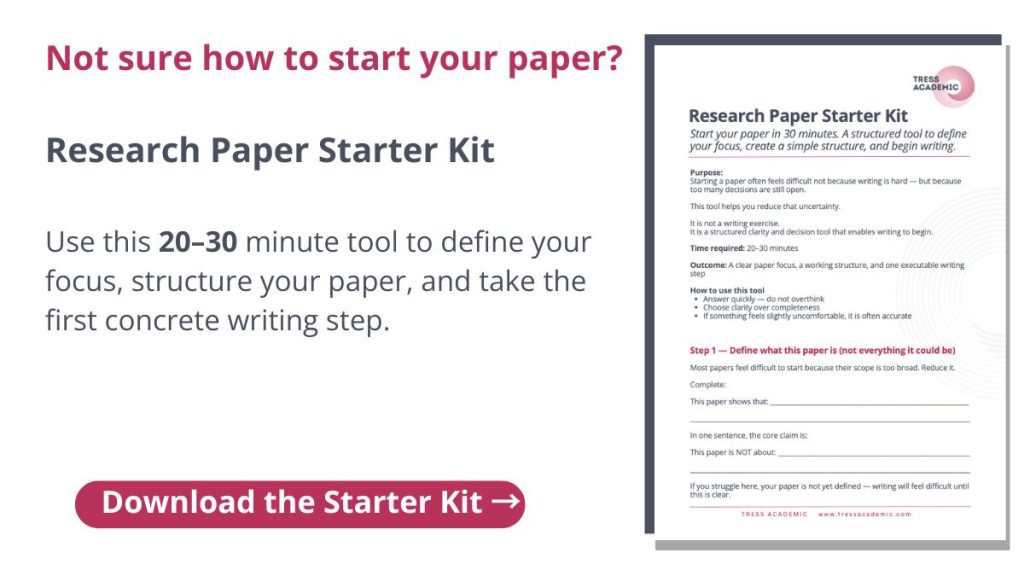
We have created a short practical tool for this:
Research Paper Starter Kit
A focused 20–30 minute worksheet to help you:
- define your paper’s core idea
- create a clear working structure
- identify your next writing step
👉 Download the Research Paper Starter Kit
7. Where it usually breaks down
This process often breaks down when researchers try to keep too many options open. That is understandable. After spending months or years on a project, it can feel uncomfortable to leave material out. Yet selection is part of writing a paper. A paper becomes stronger when it is focused enough for the reader to follow.
Another common difficulty is treating all results as equally important. In most papers, they are not. Some results carry the argument. Others provide context, support, or nuance. If this hierarchy is unclear, the paper can become crowded and difficult to structure.
A third difficulty appears when the contribution is postponed until the discussion. The paper then describes results for too long before telling the reader why they matter. A stronger approach is to let the contribution guide the whole paper from the beginning, even if it is developed fully only later.
These problems are not signs that the research is weak. They are signs that the paper has not yet been shaped clearly enough.
8. From insight to full process
Once you have defined the paper’s focus, the next stages become more manageable. You can build the introduction around the problem the paper addresses. You can select the results that support the central claim. You can use the discussion to interpret what the findings change, rather than simply repeating what was found.
This does not mean the rest of the process becomes effortless. Drafting, revising, integrating feedback, and preparing for submission all require further decisions. Yet those decisions become easier when the paper has a clear direction.
This is also why structured writing support can make a significant difference. Writing a paper is not one task, but a sequence of transitions: from results to focus, from focus to structure, from structure to draft, from draft to revision, and from revision to submission. When these transitions remain implicit, papers often stall.
When they are made explicit, progress becomes easier to sustain.
9. Conclusion
Having results is an important stage in a research project, but it is not the same as having a paper.
A paper begins when the results are shaped into a focused argument. This requires selection, structure, and a clear sense of contribution. Without that, writing easily becomes slow and fragmented because too many decisions remain open at the same time.
You do not need to include everything you found.
You need to decide what this paper is meant to show.
Once that decision is clearer, the material becomes easier to organise, and writing becomes more directed.
Use the Research Paper Starter Kit — a short tool to help you define your focus, create a working structure, and move forward.
👉 Get the Research Paper Starter Kit
Resources & Further Reading
- How to start writing a research paper when you feel stuck
- How to Structure a Research Paper: A Simple Template That Works
- How to find a paper topic
- How to work on your paper without struggle
- Research Communication in the Age of AI: Why Academic Writing Still Matters
Related programme
If you would like structured guidance from idea to submission, you may be interested in the Paper Writing Academy (PWA).
The programme supports researchers through the full process of developing a manuscript, including focus, structure, drafting, revision, and submission preparation.
👉 Learn more about the Paper Writing Academy
© 2026 Tress Academic